AtariVideoMusic.net
US Patent 4,081,829
"Audio Activated Video Display" — Robert J. Brown, assigned to Atari Inc. Filed August 23, 1976. Granted March 28, 1978.
At a Glance
| Patent number | US 4,081,829 |
|---|---|
| Title | Audio Activated Video Display |
| Inventor | Robert J. Brown |
| Assignee | Atari, Inc. |
| Filed | August 23, 1976 |
| Granted | March 28, 1978 |
| Status | Expired 1995 — in the public domain. The design may be freely studied, built, and cloned. |
| Original PDF | Download from Google Patents (PDF) |
The Official Abstract
"An interface unit for providing visual color display of objects on an unaltered TV receiver which are directly associated with the music on an audio source. Audio energy is derived from separate channels of a stereo system. This audio information is presented on the screen in the form of objects in various arrangements. Color is derived based on the zero crossing rate of each channel. Each channel has its own color associated with it. Objects may be solid, or rings, or one may be 'subtracted' one from the other. If desired, the different arrays may be selected automatically in a random manner. A spectral color modulator using phase shifted techniques is incorporated." — US 4,081,829, Abstract
Plain-English Walkthrough
1. Getting audio in
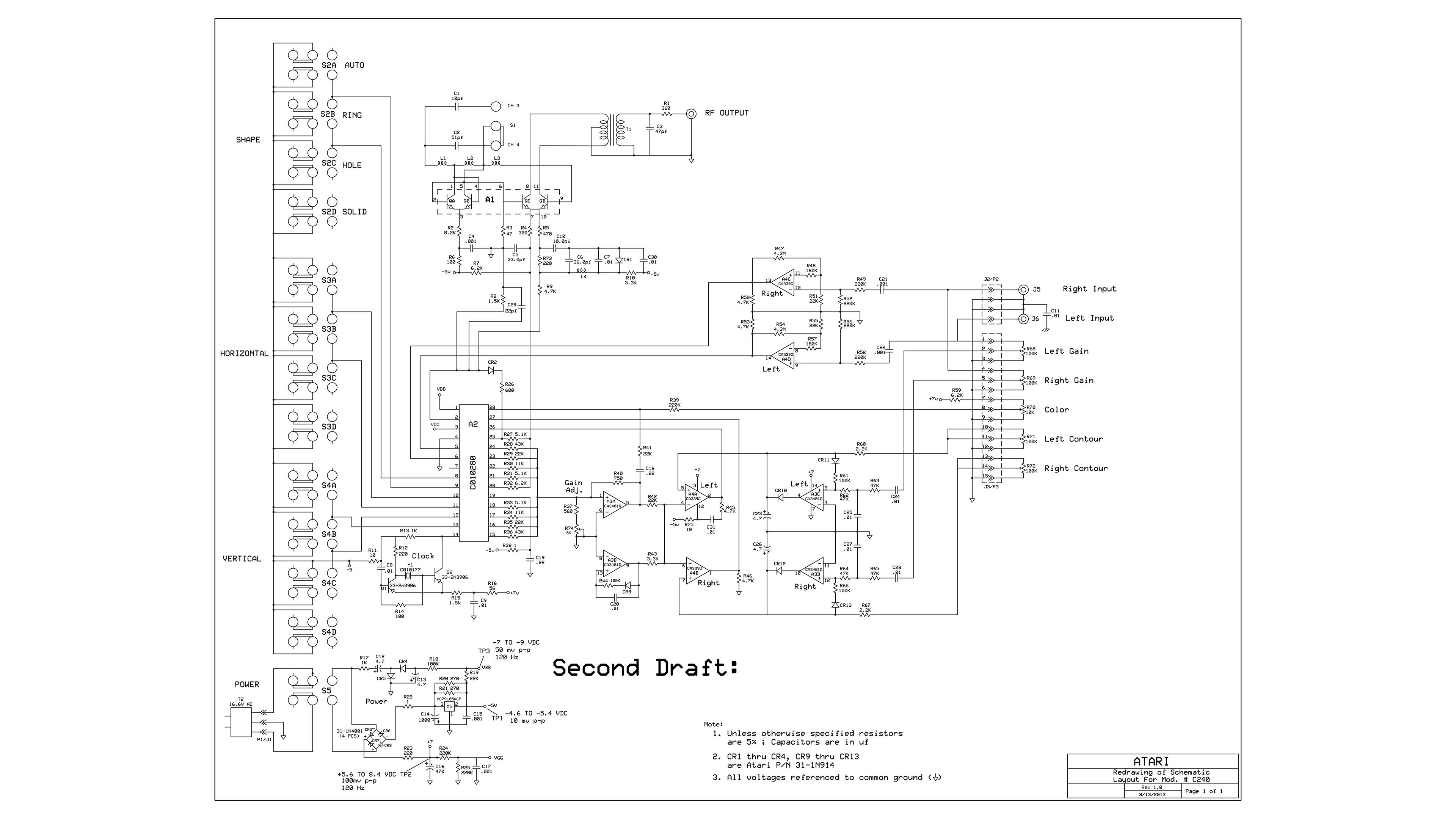
The system taps the left and right channels of a stereo amplifier through RCA jacks. Each channel's signal is amplified and then analyzed two ways: an energy detector measures how loud the signal is (this drives brightness and pattern size), while a zero-crossing detector counts how often the waveform crosses zero volts — a rough measure of pitch/frequency content, which drives color.
2. Drawing the diamonds
Ramp generators create V-shaped voltage waveforms synchronized to the television's horizontal and vertical scan. Comparing the audio-derived level against these ramps carves out diamond-shaped regions on screen — one diamond per channel, the left channel's diamond enclosing the right's. Louder audio pushes the comparison threshold, so the diamonds literally breathe with the music.
3. Coloring the shapes
Color comes from a spectral color modulator built on phase-shifted MOS delay circuits: the zero-crossing rate of each channel shifts the chroma phase, so higher-frequency audio content produces different hues. Each channel gets its own independent color. The front-panel COLOR knob biases this system from solid hues to full rainbow cycling.
4. Shape modes
Simple logic combines the two channels' shape signals in different ways:
- Solid — the shapes are OR-ed together and filled.
- Hole — an exclusive-OR "subtracts" one shape from the other, punching a hole in the middle.
- Ring — a delayed copy of the shape signal is combined with the original, leaving only an outline.
5. Arrays and auto mode
Counter circuits can multiply the image into rows and columns — up to eight repetitions horizontally or vertically. In AUTO mode, natural variations in the audio itself drive pseudo-random selection of shapes, arrays, and colors, so the display never repeats exactly.
6. Getting it onto the TV
The final composite signal feeds an RF modulator tuned to VHF channel 3 or 4, so the unit works with any unmodified 1970s television via its antenna terminals — exactly the same trick Atari's game consoles used.
Claims summary: the patent's claims cover ramp signal generation, audio comparison for luminance and chroma, zero-crossing color modulation, shape selectors, array multiplication, and random (auto) variation — essentially every front-panel feature of the production C-240.
Now in the Public Domain
Under the patent law in force at the time, US patents ran 17 years from grant — so US 4,081,829 expired in March 1995. Since then, the Video Music's design has been in the public domain: anyone may legally study the schematic, build a faithful recreation, or design a modern clone without a license. That expiration is a quiet but important part of the machine's survival — it's what makes open documentation, community repair guides, and homebrew builds possible, and it's part of why this archive can exist at all.